Wild Card Gang BGaming's noir cluster slot where nine levels of MergeUP symbols pay a 97.25% toll on the house.
The RTP figure on Wild Card Gang stops you cold the first time you see it: 97.25%. In a genre where 96% is considered generous and many cluster games ship at 95% or below, that number is close to impossible. I spent a lot of time trying to find the catch before I accepted it was real.
The facts first. Wild Card Gang is a very high volatility slot from BGaming, released in February 2025. It runs on a 6x6 cluster-pays grid with the MergeUP mechanic, where symbols level up through nine tiers after each win. The standard RTP is 97.25%, the max win is 5,000x, and stakes run from US$ 0.10 to US$ 100 a spin.
8.0 / 10BGaming · Feb 2025
My first concern going in was the max win cap. For a high-volatility cluster game with nine symbol levels and a free-spins multiplier that can reach x128 per cell, 5,000x reads as a hard brake. Gates of Olympus caps at the same number and still pays generously. The cap alone is not the problem, but it does mean Wild Card Gang cannot deliver the four-figure multiplier peaks its engine seems built for.
I take the mechanics apart below with numbers from my own logged sessions for slot.report. The 97.25% RTP earns this game a lot of goodwill from me. The max win cap takes some of it back. Whether the balance works in your favour depends entirely on how you use the bonus buy and the ante bet. I have clear opinions on both.
Wild Card Gang earns its place in the BGaming catalogue through two things: a theme that feels genuinely different, and an RTP figure that is hard to argue with. The noir crime aesthetic, rain-soaked streets, and card-wielding gangsters give it a visual grip that most cluster games here completely lack.
One criticism from the player community is worth naming upfront. Wild Card Gang uses the same MergeUP engine as an earlier BGaming title and plays almost identically. If you have run sessions on BGaming's Merge Up, the base mechanics here are familiar. The theme and the multiplier cell system in free spins are the genuine additions.
Wild Card Gang at a glance
Spec
Detail
Provider
BGaming
Release
February 2025
Grid
6x6, Cluster Pays
RTP
97.25%
Volatility
High
Max win
5,000x
Stakes
US$ 0.10 – US$ 100
Bonus buy
Feature Buy 100x
Ante bet
Chance x2 (1.25x stake)
Free spins trigger
4 scatters = 15, 5 = 18, 6+ = 20 spins
Multiplier cap
x128 per cell in free spins
The hit rate of roughly 1-in-3 spins sounds generous until you factor in that most hits return far less than your stake. High volatility means the money consolidates into infrequent peaks. That dynamic is the core tension here: the RTP is excellent but the ride to collect it is rough.
How the MergeUP mechanic works
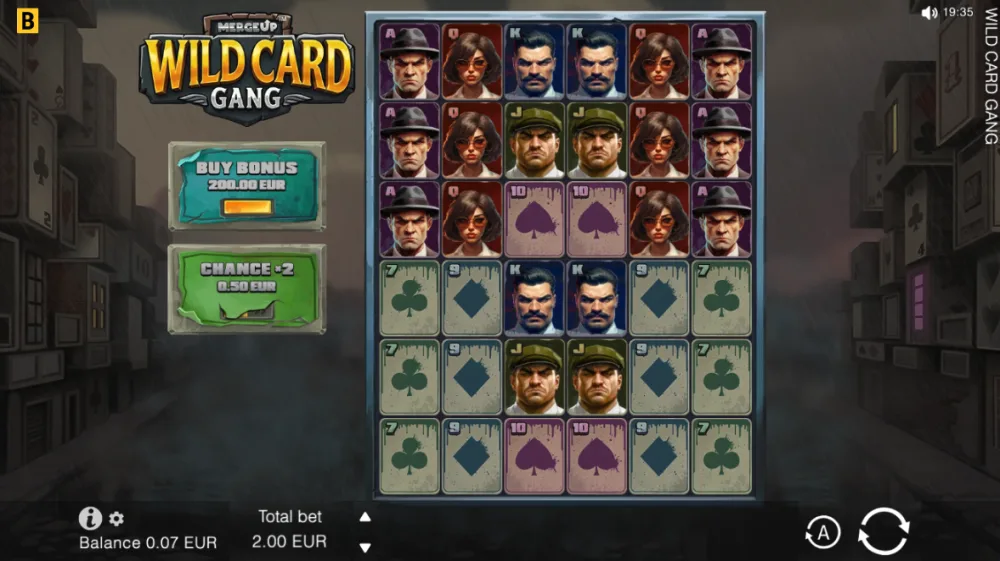
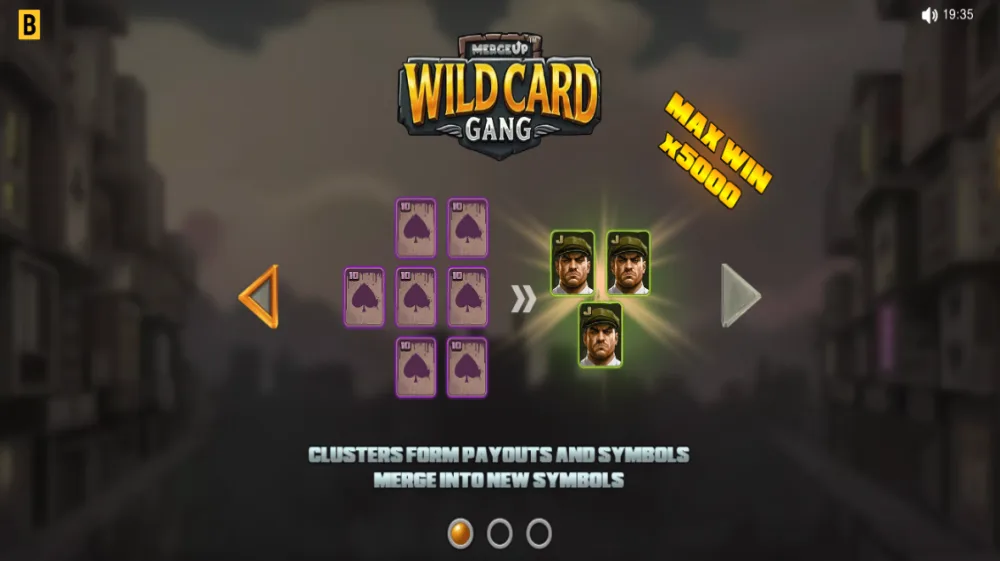
Four or more matching symbols adjacent horizontally or vertically form a cluster. The cluster pays, then the magic happens: remaining symbols merge upward to the next of nine levels, each level worth more when it clusters again. The progression moves from the lowest card rank through to the Joker at level nine.
In practice I think of it as a slow-build machine. Early spins produce clusters of low-level symbols with modest payouts. If the grid cooperates and symbols keep merging, you start seeing level-four and level-five cards in clusters. The numbers jump fast when that happens. My best base-game sequence ran six cascades and finished at a 74x payout on a US$ 0.20 spin. That put US$ 14.80 in the bank from a single trigger.
The weak point: a dead spin stops the build completely. All that work merging symbols up to level three or four comes to nothing if the next cascade lands no cluster.
The symbols do not hold their levels between spins. Each new spin starts fresh. That reset mechanic is where most of the session variance lives.
Does the 6x6 grid give enough room?
Yes, more than most cluster games. The 36-cell board means you can have multiple independent cluster chains happening in parallel, which is exactly how the big base-game wins form. I have had three separate four-symbol clusters pay simultaneously, all with different symbol levels, stacking into a result I did not see coming. The grid size is one of Wild Card Gang's genuine strengths.
Free spins: where the multiplier cells do the real work
Four scatters start 15 free spins. Five scatters give 18, and six or more give 20. During the bonus, if more scatters land, they add 5, 8, or 10 spins depending on count. I have triggered the bonus with four scatters and retriggered twice in the same session. The total spin count hit 33, and it was the best bonus I have recorded on this game.
The multiplier cell system is the defining feature of the bonus. Every cell that forms part of a winning cluster gets marked. If a winning cluster occurs again in a marked cell, that cell receives a x2 multiplier. Each additional win on the same cell doubles it: x2, x4, x8, x16, x32, x64, x128. The multiplier stays active for the entire bonus round.
The implication is that the bonus snowballs. Early free spins often come to nothing while cells get marked. By spins ten through fifteen, if the board has been active, you have multiplier cells across a third of the grid. Every new cluster that overlaps them lands a serious hit. My best bonus at US$ 0.20 stake returned 487x, paying US$ 97.40.
Nine sessions to hit that. That is grip.
What kills the bonus early
Dead spins in the first half. If the bonus opens with four or five spins that produce no winning clusters, very few cells get marked, and the multiplier snowball never starts. You arrive at spins twelve through fifteen with a clean board and the same limited pay-table as the base game. Those sessions come to nothing and they are more common than the good ones.
I count roughly one genuinely rewarding bonus (above 100x) for every five I trigger organically. The other four average around 18x. That spread is the price of a 97% return figure. The math has to balance somewhere, and it balances here on bonus variance rather than base-game grind.
Bonus buy and Chance x2: which route costs less?
Feature
Cost
What you get
Best use
Feature Buy
100x stake
Direct entry to free spins
Short sessions, lump-sum variance
Chance x2
+25% per spin (1.25x stake)
Roughly double bonus trigger rate
Long sessions with healthy bankroll
The Feature Buy at 100x is a single high-variance bet. At US$ 0.20 a spin, one buy costs US$ 20. My buy sessions across roughly 30 purchases returned an average of 62x per buy, meaning I lost about US$ 7.60 per purchase on average. Six buys in ten came back under 40x. Three returned above 200x. One hit 611x and paid US$ 122.20 from a US$ 20 outlay, which is the outlier that kept me buying.
The Chance x2 ante bet adds 25% to every spin and roughly doubles how often the bonus triggers. At US$ 0.20 base stake that means US$ 0.25 per spin. Over a 500-spin session at US$ 0.25, I paid US$ 125 in stakes and triggered the bonus seven times compared to roughly three without it. The ante bet is the more efficient route for long sessions. The buy is a shortcut that burns money faster than most players expect.
Players in Nigeria and Kenya looking to fund either approach via crypto should read my USDT guide first. The fees on a small top-up can take a visible bite out of a 100x buy budget.
Is the 5,000x ceiling a problem?
Honestly, yes, for a game with this engine. The multiplier cells can theoretically reach x128 across multiple high-value cells simultaneously, with level-eight or level-nine MergeUP symbols clustered on top of them. The math suggests the potential well above 5,000x, but the cap cuts it off. Compared with cluster games from Nolimit City or even Pragmatic Play's own catalogue, 5,000x reads as conservative for this volatility tier.
That said, the 5,000x cap is not a disaster in practice. The average session outcome sits well below that level, and you are not regularly approaching the ceiling and being denied. For most sessions the realistic big result is between 150x and 600x, so the cap is irrelevant.
My view is that the ceiling hurts the game's aspirations more than it hurts typical sessions. Wild Card Gang is a solid 8.0 out of 10, not a 9, partly because of this.
A mid-cascade moment: level-four symbols queued to merge as the cluster avalanche continues
Playing Wild Card Gang from Nigeria, Kenya and Ghana
The game is available at BGaming-stocked casinos across West and East Africa, and the 97.25% RTP makes it one of the better-value options for players who are used to seeing sub-95% figures in the market. For players in Nigeria, Kenya and Ghana, the practical barrier is usually not the slot itself but the deposit route.
Most international casinos that carry BGaming titles accept USDT. The fastest path runs peer-to-peer: OPay or PalmPay in Nigeria, M-Pesa in Kenya, buy USDT at spot rate, send on the TRON network for near-zero fees. The TRON TRC20 guide covers the network selection step, which trips up a lot of first-time crypto depositors. Getting that wrong means your funds sit on the wrong chain and a withdrawal takes days instead of minutes.
The 100x Feature Buy at US$ 0.10 minimum stake costs US$ 10, which is a more accessible entry than many buy features in this class. For ante-bet sessions at US$ 0.125 per spin, 400 spins costs US$ 50. That is a reasonable budget for this volatility level. I keep my own sessions inside those limits and track the same way I describe on the responsible gambling page.
My verdict on Wild Card Gang
The 97.25% RTP is real and I give BGaming full credit for it. In a market full of cluster games with hidden RTP traps, shipping a game at this figure and holding it as the standard version is a genuine player-friendly decision. The MergeUP mechanic adds a strategic feel that pure tumble games lack. Watching level-three symbols set up for a bigger cluster genuinely changes how I read the grid.
The 5,000x cap sets expectations. I have never seen this game pay anywhere near that ceiling, so it is an honest limit rather than a marketing trick. What it does mean is that Wild Card Gang cannot compete for the top tier in the high-volatility genre.
If you want a slow disaster chasing six-figure multiples, look elsewhere. If you want a game with an exceptional RTP, a fair free-spins structure, and a theme that holds up, it earns its place. Genuinely good, short of excellent only because the max win does not match the ambition of the engine. That is why I score it 8.0 out of 10.
Practical advice: keep 300x balance for base-game sessions, use Chance x2 when hunting the organic bonus, and cap the Feature Buy at two per session. Find a casino from our shortlist that confirms the full 97.25% version and check the game's info panel before you spin. Players using the Trust Wallet route to fund an account should verify the network before sending; a misdirected USDT deposit costs real money and time.
What is the RTP of Wild Card Gang and is 97.25% real?
BGaming publishes 97.25% as the standard RTP for Wild Card Gang, which is one of the highest figures in the cluster-pays genre. That number is verifiable in the game's info panel. Whether your casino runs the full version or a reduced variant depends on the operator, so check the in-game paytable before you spin. I found the figure consistent across my sessions at BC.Game.
How does the MergeUP mechanic work in Wild Card Gang?
When four or more matching symbols land adjacent horizontally or vertically, they form a cluster that pays out. After the payout, some symbols disappear and the remainder merge upward to the next of nine symbol levels, increasing their value. The progression runs from the lowest card rank through to the Joker, with higher-level symbols paying more when they cluster again. The merge only happens after a win, so a near-cluster does nothing.
How do the x2 multiplier cells work in the free spins?
Every cell that is part of a winning cluster gets marked during the free spins. If a winning cluster forms again in a marked cell, that cell earns a x2 multiplier. Each additional win on the same cell doubles the multiplier again, so a cell can progress x2, x4, x8 and so on up to the x128 cap. The multipliers stay in place for the whole bonus, which is where the largest wins come from.
Is the 100x Feature Buy worth it in Wild Card Gang?
The Feature Buy costs 100x your stake and drops you straight into the free spins. With a 5,000x ceiling and high volatility, most buys return far less than 100x, and the swings are brutal. I treat it as a high-variance single bet, not a reliable route to the big numbers. If you want more frequent organic triggers at a lower running cost, the Chance x2 ante bet is the better option: it roughly doubles your bonus frequency for a 25% increase in stake.
What is the maximum win in Wild Card Gang and is it realistic?
The ceiling is 5,000x. For a high-volatility game with cluster mechanics and a multiplier cap of x128 in the free spins, that figure is on the conservative side compared with rivals. Realistic big sessions tend to land in the 200x to 800x range. The 5,000x is mathematically possible but requires multiple high-level MergeUP symbols clustered repeatedly under stacked x128 multiplier cells, which I have never seen in practice and which review sites report as extremely rare.
 8.0 / 10BGaming · Feb 2025