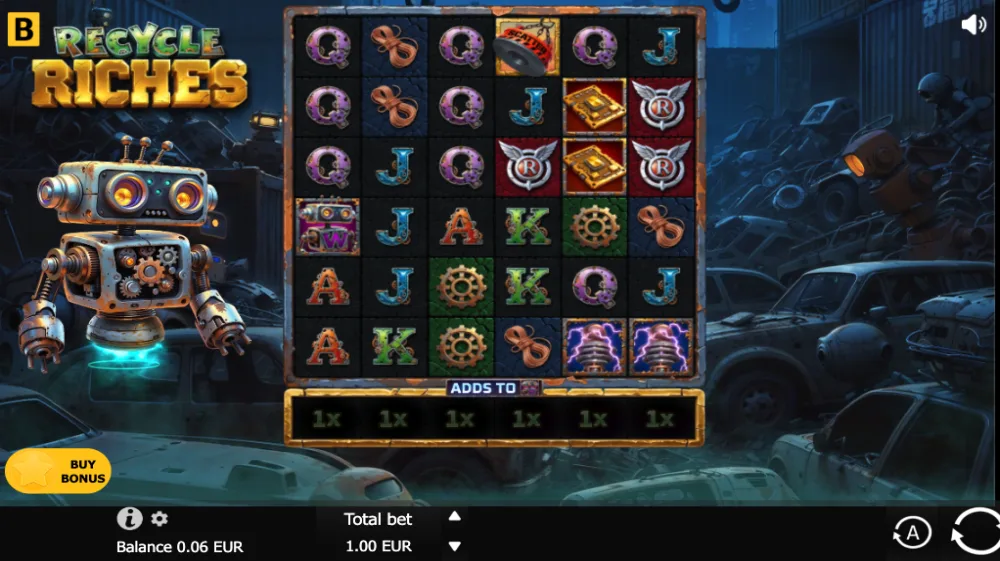
Recycle Riches The BGaming cluster slot where two multiplier systems share one grid. Only one of them is obvious.
Most cluster slots give you one multiplier mechanic and call it a day. Recycle Riches drops two onto the same 6x6 board and asks you to track both at once. That is either clever design or an overcomplicated mess. After several sessions I know which one it is, and it depends almost entirely on which bonus tier you paid for.
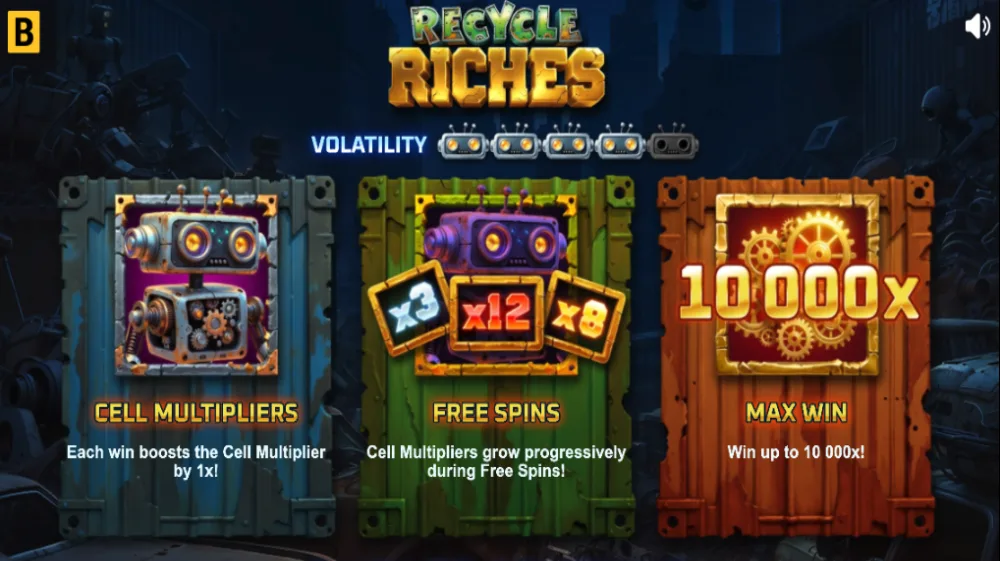
The specs: Recycle Riches is a high volatility slot from BGaming, released in March 2026. The theme is a sci-fi recycling factory with a robot companion and retrofuturistic machinery. RTP sits at 96.14%, max win is 10,000x, and stakes run from US$ 0.10 to US$ 100. Clusters need at least 5 connected symbols to pay.
7.0 / 10BGaming · Mar 2026
I went in expecting another Tumble-with-multipliers clone. What I found was a game that genuinely rewards understanding the difference between its two multiplier types. Players who ignore that distinction pay for it. The 300x buy at US$ 0.10 costs US$ 30 a round. That is a toll worth knowing before you press it. Below I break down how the dual multiplier system works, where it earns its 7.0 score, and what players in Nigeria, Kenya and Ghana need to know about funding a session before they spin the first cluster.
The first thing that sets Recycle Riches apart from other cluster slots is the decision to run two completely separate multiplier systems simultaneously. Most studios pick one and build the whole bonus around it. BGaming layered both on the same grid. Whether that works for you depends on how much you enjoy reading a mid-session pay table, so let me take the numbers apart.
Recycle Riches at a glance
Spec
Value
Provider
BGaming
Release
March 2026
Grid
6x6
Win mechanic
Cluster pays (5+ connected symbols)
RTP
96.14%
Volatility
High
Max win
10,000x
Stakes
US$ 0.10 – US$ 100
Free spins trigger
3–6 scatters → 6–12 spins
Hit frequency
~1 in 3.45 spins
The 96.14% RTP is solid. Compare that to a typical high-variance release from a major studio, which usually lands around 96.00–96.50%, and this sits in the right range. The 10,000x ceiling is double what Gates of Olympus offers at 5,000x. Getting anywhere close requires the kind of free-spins run that happens maybe once in several hundred thousand rounds.
How the two multiplier systems actually work
The game has cell multipliers and reel multipliers. They are not the same thing and they do not work the same way. I see them confused constantly in player discussions, so here is a clear account. For context on how other cluster formats handle multipliers, the BGaming hub has all the studio's titles in one place.
Cell multipliers live on individual grid positions. Each position starts at x2. Every time a winning cluster covers that position, the value goes up by 1. A cell hit four times is now x6. In the base game these values reset every spin. In free spins they do not reset. They stack across every cascade and every spin in the bonus, which is where the big numbers come from.
Reel multipliers are different. They come from Tesla Coil symbols landing on the grid. Values run from x1 to x100 and are additive: two Tesla Coils worth x20 and x30 give you x50 on that reel column, not x600. Wild symbols pick up the active reel multiplier when they form part of a winning cluster. During free spins, these also persist and grow instead of resetting.
What happens when both fire at once
That is where Recycle Riches justifies its theme. When a cell value of x8 and a Tesla Coil reel value of x40 are both active at the same column, the two combine on any winning symbol at that intersection.
I logged one cascade where a cluster touched 3 positions with values between x5 and x9, plus a x25 reel multiplier running alongside. The result was a 340x cascade from a US$ 0.20 spin, which works out to US$ 68. Numbers like that do not come to nothing when the system is firing right.
The base game, though, is a slow disaster between those peaks. Hit frequency of 1 in 3.45 means plenty of blank spins. The position values reset every round, so the base game rarely builds any grip before the run ends.
Bonus features in detail
Three or more scatters trigger the free spins. The count scales with how many scatters land: 3 scatters give 6 spins, 4 give 8, 5 give 10, 6 give 12. Retriggering is possible up to two times. The key difference in free spins is that both cell multipliers and reel multipliers persist across all spins and cascades. They only reset when the round ends.
That persistence is what separates Recycle Riches from cluster slots that reset on every spin, including some well-known titles like Sweet Bonanza. It is also the entire reason the max win reaches 10,000x. A 12-spin bonus with two retriggers and a hot Tesla Coil run can push the combined multiplier high enough to reach four-figure results. My best bonus session paid 520x from a 100x buy. My worst paid 8x from the same entry price.
Bonus buys: what each tier actually does
Buy option
Price
What you get
Chance x3
2x stake
Triples free spins trigger probability for one base spin
Free Spins
100x stake
Direct entry into free spins (scatter count = random)
Max Free Spins
300x stake
Guaranteed 12 free spins from the start
At US$ 0.10 stake: Chance x3 costs US$ 0.20 per spin, the 100x buy costs US$ 10, and the 300x buy costs US$ 30. At US$ 1 stake those figures become US$ 2, US$ 100, and US$ 300. The Chance x3 option is the most efficient of the three for hunting the bonus without committing to a full purchase. I use it during longer base-game sessions when I want to tilt the odds without burning a full toll entry.
The 300x buy removes the randomness of scatter count but not the randomness of what the multipliers do once the round starts. You pay for certainty on spin count; everything else is still variance.
Is the bonus buy worth it?
For disciplined sessions, the 100x buy is the better entry point than the 300x. The difference between 6 and 12 free spins matters less than most players expect. The values that accumulate depend entirely on which positions get hit and how often. A 6-spin bonus with a strong reel multiplier active can outpay a 12-spin bonus that comes to nothing. It depends on which positions the cascades hit.
My own buy sessions: roughly 60% of 100x buys returned under 60x, making a net loss on that purchase. About 25% landed between 60x and 200x. The remaining 15% went above 200x, with two sessions above 400x. That distribution looks familiar if you have spent time on cluster slots from other studios. The game's variance is real, and the 300x premium buys comfort, not better odds.
The sensible approach is a session balance of at least 300x your stake before touching the 100x buy, and 600x before the 300x. I cover how I set limits in the responsible gambling section. Set them before you open the front door, not after the first dry run. Gambling should stay entertainment, and keeping a hard budget enforces that.
I started at US$ 0.20 a spin on a balance of US$ 60, which gave me 300 spins of runway. The base game held its ground for the first 80 spins. A hit frequency of 1 in 3.45 kept the session alive, even when the clusters paid small. Cell multipliers flickered above x3 on a few positions before the round ended and reset. That pattern repeated itself several times: brief build, reset, restart.
The first free spins trigger came from 4 scatters, 8 spins. Early in the round the cell multipliers climbed slowly across the left side of the grid. Then a Tesla Coil symbol landed carrying a x15 reel multiplier, and the next cascade crossed three positions already at x4 or x5. The round paid 87x. I noted two positions in the bottom-left corner that were hit six times each and had cell values of x8 by the end.
I bought the 100x option twice during that session. First buy paid 48x, which is a dead spin relative to the US$ 10 entry. Second buy paid 312x, which at US$ 0.20 stake means US$ 62.40. A good day by any measure for a US$ 10 outlay. My overall session ended slightly above flat. For a high variance slot at US$ 0.20, that counts.
Cell multipliers (per position) and Tesla Coil reel multipliers both persist through the entire free spins round
One honest note on the theme. The sci-fi factory aesthetic is more interesting than the usual fruit grid. The robot character animation adds something when a big cascade fires. It does not change the math, but it does make a slow-burning bonus session easier to stay with.
Playing Recycle Riches from Nigeria, Kenya and Ghana
BGaming titles show up across the main African-facing casino platforms. Recycle Riches is available at BC.Game and winz.io, both on our casino shortlist. Funding is where the practical friction lives, not the slot itself.
In Nigeria the realistic deposit route is OPay or PalmPay to a peer-to-peer exchange, then USDT on the TRC-20 network into your casino wallet. The guide on what USDT is covers the basics if crypto is new to you. The TRON TRC-20 guide covers network fees so a withdrawal does not get stuck on the wrong chain.
Nigeria's 5% withholding tax on winnings applies from January 2025. The casino does not deduct it automatically, so keep your own records.
In Kenya, M-Pesa is the central funding rail. The path from M-Pesa to USDT via Binance P2P or Yellow Card works for most players. Our Kenya casino guide steps through KYC timing, the most common complaint at international operators for Kenyan players.
Ghana's 10% tax on winnings was removed in April 2025, so the full payout is yours to keep. Players there primarily use MTN Mobile Money (MoMo) or Telecel Cash before converting to USDT. The Trust Wallet guide covers the crypto leg on all three markets.
For players in these markets, a slot like Recycle Riches at US$ 0.10 minimum stake gives enough runway to test the mechanic without heavy commitment. At US$ 0.10 per spin, 500 spins costs US$ 50. That is a reasonable runway for learning how the system behaves before stepping up to buy entries. Our Nigeria and Ghana pages list which operators clear deposits fastest. Speed is always the top concern for players funding from local rails.
Verdict: a 7.0 that earns it on the mechanic, not the theme
Recycle Riches scores 7.0 because the dual multiplier system is well designed and 96.14% RTP is honest. The reason it does not score higher is the base game, which offers little grip between triggers. A hit rate of 1 in 3.45 spins sounds reasonable until you realise that most base-game pays are small enough that position values reset before building anything worth watching. You are essentially marking time until the bonus fires.
When the bonus does fire, the game delivers. The combination of persistent cell multipliers and Tesla Coil reel multipliers gives a bonus round more texture than a standard collect-and-multiply mechanic. Two multiplier types competing for the same grid positions means the outcome is harder to predict, and that uncertainty is, in this case, interesting rather than frustrating.
My advice: use the Chance x3 option at 2x stake to hunt the trigger rather than jumping to the 100x buy. If you are going to buy, set your limit before you open the game, not after the first empty round. The how we test page explains the framework I use across all reviews, including variance testing and how I record bonus sessions. For the full BGaming catalogue on this site, start at the BGaming hub.
What is the RTP of Recycle Riches and does the bonus buy change it?
The RTP is 96.14% across the base game. BGaming does not publish separate buy-mode RTP figures for this title, so I treat all three buy tiers as the same 96.14% baseline. That is a reasonable number for a high-volatility cluster slot. Check the game's info panel at your casino before you stake anything larger.
How do the cell multipliers and reel multipliers work together?
They are two separate systems that combine. Cell multipliers start at x2 on each grid position and go up by one every time that position is part of a winning cluster. Reel multipliers come from Tesla Coil symbols and range from x1 to x100 additively. During free spins neither resets between spins, so the numbers compound across the entire bonus. A position that has been hit four times sits at x6, and if a x30 reel multiplier is also active, the two values stack together on that symbol.
Is the 300x Max Free Spins buy worth it?
At US$ 0.10 stake the buy costs US$ 30 and locks in 12 free spins from the start. Whether that is worth it depends on your session balance. The guaranteed 12 spins avoid the frustrating low-count trigger (6 spins from 3 scatters), but the actual multiplier values you build from those positions are still random. I treat the 300x buy as a premium you pay for certainty, not for better average returns.
Why did my cluster disappear without paying anything?
Clusters must be 5 or more identical symbols connected horizontally or vertically. A group of 4 counts as nothing, regardless of its position or colour. The 6x6 grid gives you 36 positions, but the minimum cluster size is the rule that catches most players off guard. It is not a bug. Hit frequency sits around 1 in 3.45 spins, so plenty of non-winning spins are normal.
What is the maximum win and is it realistic?
The ceiling is 10,000x. Getting there requires a rare alignment of high cell multipliers and Tesla Coil reel multipliers during free spins, plus a cascade that hits the right positions repeatedly. In practice, most paid bonuses land between 30x and 300x. Five-figure clips exist but should be treated as statistical outliers, not a target. At US$ 0.10 stake the cap is US$ 1,000; at US$ 1 it is US$ 10,000.
 7.0 / 10BGaming · Mar 2026