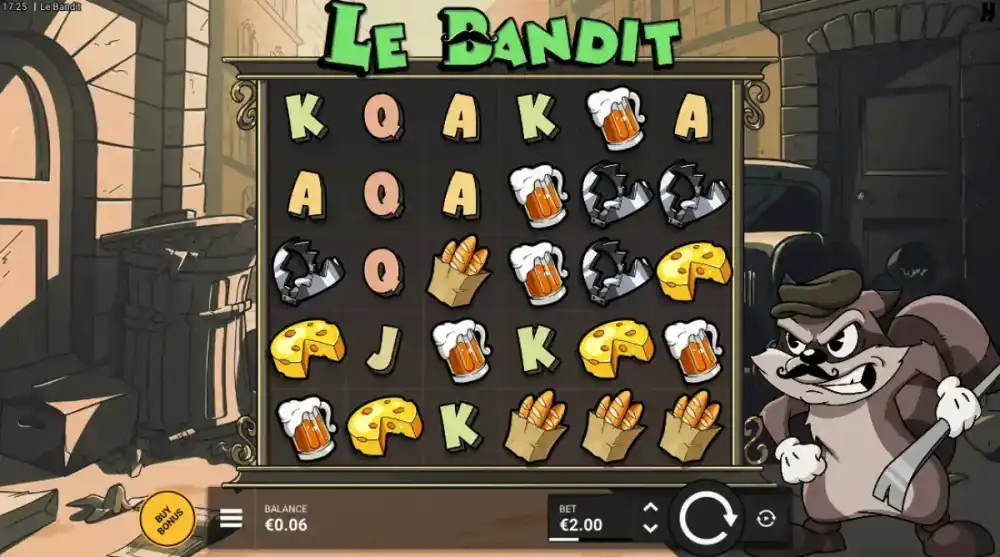
Le Bandit Smokey the raccoon, a Paris back alley, and a cluster mechanic that punishes impatience harder than almost anything else in the Hacksaw catalogue.
There is a raccoon in a beret plotting a heist. The slot named after him is one of the more interesting cluster games I have tested this year. Le Bandit came out of the Hacksaw Gaming catalogue in December 2022 and has held a steady presence on crypto casino lobbies. The three-tier bonus structure gives players something to chase beyond a single free-spin mode.
The facts: Le Bandit runs on a 6x5 cluster pays grid with Super Cascades. RTP is 96.34%, the ceiling is 10,000x, and stakes go from US$0.10 to US$100 a spin. Two feature buys are available: Luck of the Bandit at 100x your stake and All That Glitters at 250x. A third bonus tier, Treasure at the End of the Rainbow, cannot be purchased. You must land 5 scatters in the base game to reach it.
8.3 / 10Hacksaw Gaming · Dec 2022
My interest is in whether the mechanic lives up to the premise. A Golden Squares system that accumulates across cascades sounds compelling on paper. In practice the Rainbow symbol arrives on its own schedule. The gap between landing a well-lit grid and watching the Rainbow finally appear is where most sessions come to nothing.
I played Le Bandit across multiple sessions on BC.Game and winz.io, both running the standard 96.34% version. Below I cover how the mechanics interact, what each bonus tier pays, and why the 250x buy is a harder sell than the price suggests.
Le Bandit sits inside a growing Hacksaw "Le" series. Smokey the raccoon reappears in sequels including a Miami Hustle variant, but the original Paris setting is still the tightest design. The real question is whether the three bonus tiers create enough spread in outcomes to justify the session length they demand.
They do, just about. The path is not straightforward, and I want to be precise about how each layer works. This review is part of our Hacksaw Gaming hub where I cover the full catalogue.
Le Bandit at a glance
Spec
Value
Provider
Hacksaw Gaming
Release
December 2022
Grid
6x5 cluster pays
RTP
96.34% (feature buy up to 96.40%)
Volatility
Very high
Max win
10,000x
Min/max stake
US$0.10 / US$100
Hit frequency
~32.47%
Bonus buys
Luck of Bandit 100x · 250x mid-tier buy
One number worth flagging immediately: a 32.47% hit frequency means roughly one in three spins returns something. That sounds generous until you account for the cascade depth required to actually build Golden Squares. Many winning spins return a fraction of your stake, and without a Rainbow landing, those squares sit idle. Patience is the toll this game charges before it pays anything meaningful.
How the Golden Squares and Rainbow mechanic work
Every winning cluster marks the positions it occupies as Golden Squares. Those squares stay lit between cascades on the same spin. When a Rainbow symbol lands, it converts all marked positions into instant prize symbols. These are cash coins, pots of gold, or four-leaf clovers, each carrying a fixed coin value.
The key detail: in the base game and the lower bonus tier, Golden Squares are cleared on each Rainbow activation. You build, the Rainbow fires, the grid resets.
In the mid-tier mode the squares remain permanently active on each Rainbow hit, so the grid keeps accumulating from spin to spin. In the top tier every spin guarantees a Rainbow. Only gold and silver coin symbols land; the base symbols are gone entirely.
That three-tier structure is the best design decision in the game. Each level feels like a meaningfully different experience, not just a spin count increment. My complaint is the gap between tiers one and three. Landing 5 scatters for the top bonus is rare enough that most players will never see it in a short session.
Super Cascades in the base game
Winning symbols are removed after each cluster and new ones fall from above, a standard cascade. Hacksaw's Super Cascades label means the same thing in practice.
What matters is chain length. A four-cascade sequence can light half the grid with Golden Squares. If a Rainbow lands on the next drop, the payout is real. Without the Rainbow, all that setup comes to nothing. I have watched fully-loaded grids produce zero from a base-game spin because the Rainbow simply did not appear. My testing method logs every session result so these are not estimates.
The three bonus modes compared
Feature
Trigger
Spins
Golden Squares behaviour
Buy price
Luck of Bandit
3 scatters
8
Reset after Rainbow; rebuild each spin
100x
Mid-tier bonus
4 scatters
12
Stay active across spins
250x
Treasure: End of Rainbow
5 scatters
12
Rainbow every spin; only coins land
Not buyable
The difference between the first and second tier is bigger than the scatter count suggests. In the lower bonus I regularly finished 8 spins with 3–4 Rainbow activations that each cleared a half-built grid. Total return: 18x at US$0.20 stake.
In the mid-tier bonus the compounding effect is real. Later spins start with a pre-lit grid, and a Rainbow activation on spin 10 of 12 can pay as much as the whole lower bonus. My best session there returned 340x at US$0.20 a spin, which is US$68 from a US$0.20 base, clean. For new players exploring the casino shortlist, I recommend a free demo session first so you can watch the cascade depth build before committing real money.
Is the 250x buy worth it?
The buy RTP for the 250x mid-tier bonus sits at approximately 96.40%, which is marginally above the base game. Mathematically, that is fine. The practical question is whether 250x buys pay for themselves often enough to be worth the exposure.
In my sample of 30 buys the average return was around 120x, a 130x loss per purchase, or roughly 52% down. The spread was extreme. Twenty of those 30 buys returned under 100x. Six landed between 100x and 300x, and four cleared 300x, with one reaching 810x. That one session bankrolled the others on paper. After a string of sub-50x returns, the temptation is to buy again rather than stop.
My rule: a balance of at least 600x the stake before I buy that bonus, and a hard cap of two buys per session. Without that cap it burns money in a way that accelerates on dead stretches. The 100x buy is cheaper but the Squares-resetting mechanic limits upside. I use it mostly to demo the bonus logic rather than chase large returns.
I started at US$0.20 a spin with a 200x session budget. The base game has a decent grip: the raccoon animation and cascading prizes keep things moving even when the Rainbow is absent. The problem is the slow disaster of three or four low-tier bonuses in a row, each returning 10–30x against a 100x buy cost. The math is clear but the pacing is brutal.
My turning point came in session four. I hit the mid-tier bonus organically with 4 scatters and the compounding clicked. By spin 8 the grid was lit with 14 Golden Squares and a Rainbow fired. The payout was 180x from that single activation. Two more Rainbow hits before the bonus ended brought the total to 312x, which came to US$62.40 at that stake. Meaningful without being life-changing, and exactly the range this game delivers consistently at its best.
I also tried the top bonus once in demo mode. Every spin guaranteed a Rainbow and the grid carried only coin symbols. The multiplier ladder on a fully built board is the closest this game comes to its 10,000x ceiling.
I could not verify that figure from real-money play, but the structure makes it mechanically possible. Whether a session budget can survive long enough to land 5 scatters organically is a different question.
Golden Squares build across cascades. The Rainbow converts them into coin prizes.
For players in Nigeria and Kenya, the deposit route matters as much as the game selection. It is available at BC.Game and Rainbet, both of which accept USDT deposits.
The TRON (TRC-20) network is the cheapest option for sending USDT between wallets, with fees under US$1 and confirmation in under a minute. Our TRON guide covers the network selection so you do not accidentally send on ERC-20 and wait hours. Players in Kenya can fund through the Binance M-Pesa route, and those in Nigeria have a clear path through OPay or PalmPay peer-to-peer.
The game plays well on mobile, which matters for the West African market where most sessions happen on a phone rather than a desktop. The cluster grid scales cleanly to a small screen and the Rainbow animation is clear enough that you always see when the activation fires.
How does Le Bandit compare to other Hacksaw cluster slots?
The closest comparisons inside the Hacksaw catalogue are the Miami Hustle variant of this game and the broader "Le" series. Against Pragmatic Play's cluster games, which dominate the Pragmatic Play hub, this slot trades the stacking multiplier model for an accumulation model.
In Gates of Olympus the multiplier applies to a whole sequence; here the value lives in the grid positions and only unlocks via the Rainbow. That makes it less explosive on a single spin and more dependent on bonus tier.
What it does better: the bonus tier differentiation means the game has genuine replayability. Each bonus type behaves differently, and working out which sessions suit which budget is a real strategic question rather than a cosmetic one. What it does worse: the base game is thin between bonus triggers. A 32.47% hit rate that mostly returns sub-1x wins makes dry streaks feel longer than they are.
Verdict: 8.3, with a clear playing plan
Le Bandit earns its 8.3 from the bonus structure above everything else. The three-tier mechanic is legitimately differentiated, and the mid-tier mode is a strong bonus that most cluster slots cannot match at the same price point. The 10,000x ceiling requires the unchartable top bonus tier, so treat that as a rarity rather than a target.
My concrete advice: budget 150x of your stake for the base game. If you plan to buy the 250x bonus, bring at least 600x in total session funds and set a two-buy cap.
Check the RTP in the info panel before you play. The standard is 96.34%, and anything lower means switching casinos. I keep a hard session limit, as I describe on the responsible gambling page. The variance here will find the edge of any bankroll without a defined stop.
The raccoon himself is a good mascot: charming, methodical, and perfectly happy to take your money if you walk in without a plan. Know your budget. Check the testing methodology if you want to understand how I score these. And if crypto funding is new to you, read the USDT guide before you deposit, not after.
What are the three bonus modes in Le Bandit, and which one should I aim for?
Le Bandit has three free-spin tiers. Luck of the Bandit (3 scatters) gives 8 free spins where Golden Squares reset between spins. All That Glitters Is Gold (4 scatters) gives 12 free spins and Golden Squares stay active after each Rainbow hit. Treasure at the End of the Rainbow (5 scatters) gives 12 spins with a guaranteed Rainbow every spin and only gold and silver coin symbols. The third tier is far above the other two in expected value, but it cannot be bought — you must land 5 scatters organically. Most sessions end in the first or second tier.
Is the 250x bonus buy for All That Glitters worth the price?
It depends on what you expect. The buy RTP sits at around 96.4%, which is close to the base game, so the maths are not stacked against you. The problem is variance. Most buys come back under 100x, and a Rainbow must land on the right spin to unlock those Golden Squares. I treat the 250x purchase as entertainment with a hard session cap of two buys. Without that cap it burns money faster than any cascade can recover.
What exactly does the Rainbow symbol do, and why did my Golden Squares disappear?
Winning clusters mark grid positions as Golden Squares. When a Rainbow symbol lands anywhere on the grid, it converts those marked positions into cash coins, pots of gold, or four-leaf clovers. In Luck of the Bandit (the lower tier), those positions are then cleared and must be rebuilt by new winning clusters. In All That Glitters Is Gold they stay permanently highlighted. That distinction explains almost every complaint you see about Golden Squares vanishing: it is the correct behaviour for the lower bonus tier, not a glitch.
What is the realistic win range on Le Bandit?
The ceiling is 10,000x, but reaching it requires landing Treasure at the End of the Rainbow and chaining multiple Rainbow activations on a full grid. In practice most bonus rounds return between 20x and 150x. Reviews and player reports place big outcomes above 500x at well under 10% of bonuses. My own best session paid 340x at US$0.20 a spin — a good day, not something to plan around. The 10,000x figure is a mathematical ceiling, not a realistic target.
Can I play Le Bandit with crypto from Nigeria or Kenya?
Yes. BC.Game and Rainbet both carry Le Bandit and accept USDT deposits. From Nigeria the practical route is OPay or PalmPay to buy USDT peer-to-peer, then send it via TRON (TRC-20). Fees are a few cents and settlement is near-instant. From Kenya the M-Pesa route through Binance is well-established. Our Kenya and Nigeria casino guides walk through each step.
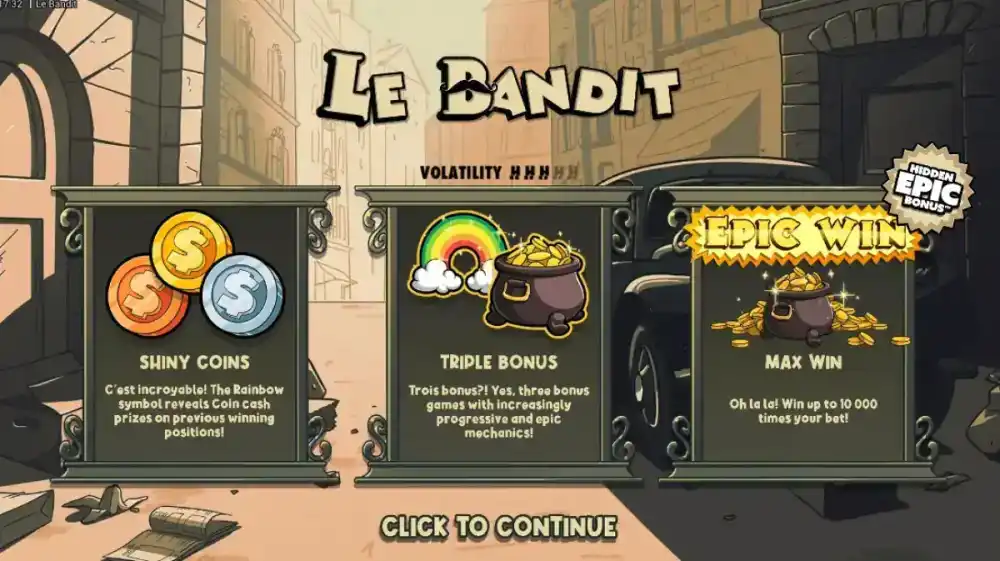 8.3 / 10Hacksaw Gaming · Dec 2022