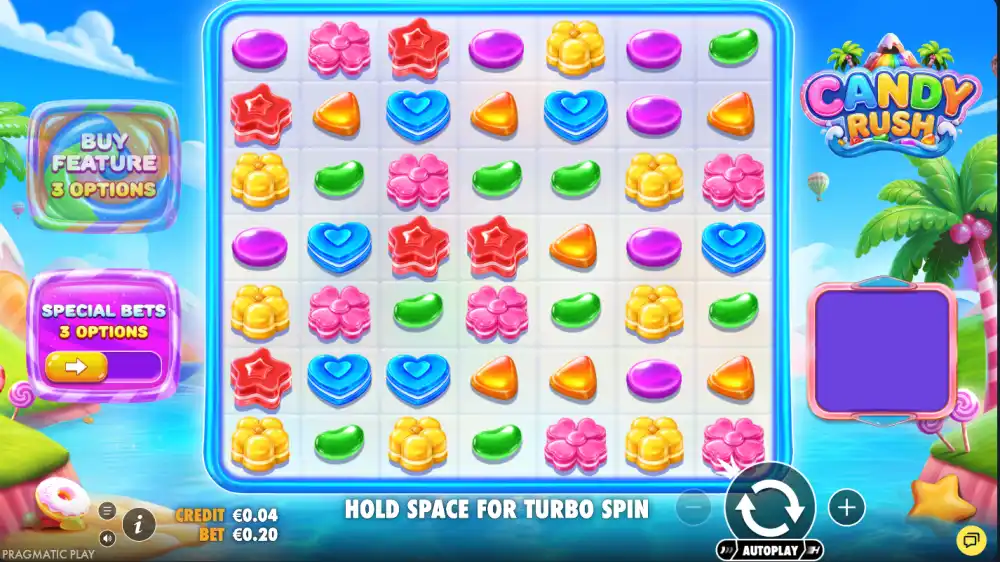
Candy Rush Pragmatic Play's 7x7 cluster-pays game where the multiplier underlay does most of the heavy lifting — when it decides to show up.
Candy Rush arrived in May 2026 and it slots neatly into the growing Pragmatic Play candy universe alongside Sugar Rush Super Scatter and Sweet Bonanza. The theme is unapologetically bright: hard-boiled sweets, lollipops, jelly bears. The mechanic is more interesting than the visuals suggest. This one is built around a multiplier underlay: a block of cells that appears beneath the symbols and doubles per winning tumble. Land the right buy and it carries its growing value into the free spins.
The facts first. Candy Rush runs on a 7x7 grid with cluster pays: five or more matching symbols touching horizontally or vertically. RTP is 96.58%. Max win is 15,000x. Volatility is officially listed as high. Stakes run from US$ 0.10 to US$ 100 per spin. Bonus trigger rate sits at roughly 1 in every 432 spins.
7.8 / 10Pragmatic Play · May 2026
My main concern going in was whether the underlay mechanic adds genuine depth or is just visual decoration on a standard tumble engine. After a few hundred spins in the demo and live play across several sessions, I have a clear answer. The mechanic is real, but the game is far stingier with the underlay than the marketing implies. Most base game spins see no underlay at all.
I also looked at the three bonus buy tiers (100x, 300x, 750x), because the differences matter more than they might appear. The gap between the 300x and the 750x buy is specifically the question I get asked most. For players in Nigeria, Kenya and Ghana where crypto is the practical deposit route, I cover the funding side too. For now, let me start with how the grid actually behaves.
The Pragmatic Play catalogue has no shortage of cluster-pays titles at this point, so the burden is on Candy Rush to earn its place. Whether it does comes down mostly to one design choice: the underlay. Everything else, the tumble, scatter triggers and free spins count, is familiar. The underlay is the differentiator. Let me explain exactly how it works before I score it.
Candy Rush at a glance
Spec
Value
Provider
Pragmatic Play
Release
May 2026
Grid
7x7
Win mechanic
Cluster pays (5+ symbols)
RTP
96.58%
Volatility
High
Max win
15,000x
Stakes
US$ 0.10 – US$ 100
Bonus trigger rate
~1 in 432 spins
The hit rate of around 35% means the grid pays something fairly often. The problem is that most of those wins are small clusters that do not touch the underlay or do not tumble enough to push the multiplier anywhere meaningful. That gap between surface activity and real money is where the high volatility classification earns its label. You can read how I test for volatility on the how we test page.
How the multiplier underlay works
On any base game spin, a rectangular underlay can appear randomly behind the symbols. It comes in sizes: 2x2, 3x3, 4x4, 6x6, or the full 7x7. It starts at a 2x multiplier. Each winning tumble that covers that underlay doubles the value: 2x becomes 4x, then 8x, with a cap at 128x. At the end of the spin sequence everything resets.
The 128x ceiling is important. This is not a game where a wild chain sends the multiplier into the hundreds of thousands, the way some mechanics permit. The ceiling is fixed at 128x per spin, which keeps the math readable and prevents the runaway variance that makes some cluster games genuinely unpleasant.
The underlay only pays out when symbols sitting over it form part of a winning cluster. An underlay beneath non-matching symbols is invisible to the payout engine. Those cells contribute nothing until a cluster forms on top of them. That matters practically: a 7x7 underlay at 64x means nothing if the tumble chain ends before it hits. I have had dead spins with a large underlay sitting in plain sight. It comes to nothing, and the reset wipes it clean.
How often does the underlay appear in the base game?
Less often than you hope. In the sessions I logged, I counted roughly one appearance every 8 to 12 spins on average, with big variation. A 7x7 underlay is noticeably rarer than a 2x2 or 3x3 in standard play. My best base game spin staked US$ 0.20 and ran 5 tumbles across a 4x4 underlay, finishing at 32x, paying out 48x the spin. Good for a base game result.
Bonus features: free spins, super free spins, and the three buys
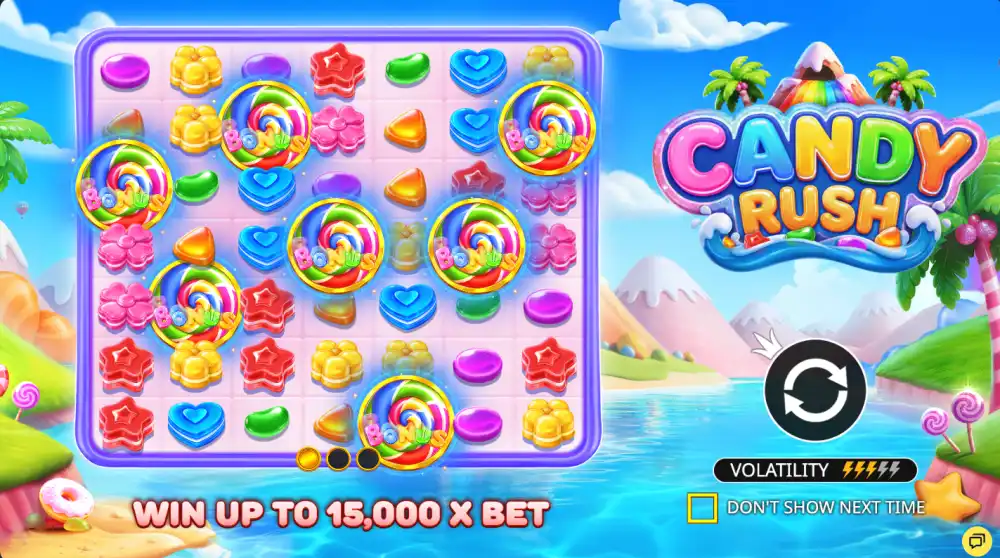
Landing 3 or more scatter symbols triggers the bonus. Before I get into the tiers, a quick note on where to play: our casino shortlist covers operators that carry the full 96.58% RTP version. The count scales with scatters: 3 gives 10 spins, 4 gives 12, 5 gives 15, 6 gives 20, and 7 unlocks 30.
During the standard free spins a random-sized underlay is guaranteed on every spin, but the multiplier resets between spins. This makes the organic round relatively modest. A few doubling tumbles, reset, repeat.
The two bonus variants change the equation. In the 300x buy (SFS 1), a full 7x7 underlay is guaranteed on every spin, still resetting between spins. In the 750x buy, the underlay size is random each spin, but the multiplier no longer resets. It carries forward, compounds across every subsequent winning tumble in the whole feature, and continues up to 128x. That persistence is the mechanic the 15,000x ceiling depends on.
The underlay during a tumble sequence — the multiplier doubles with each subsequent winning cascade
To reach anywhere near 15,000x you need a large underlay, a climbing multiplier and high-value clusters all aligned throughout the feature. Each of those conditions is individually unlikely. Together they are rare enough that I treat any session above 500x as a good day, not an expectation.
The three bonus buy tiers compared
Buy tier
Cost
What you get
RTP
Bonus Buy
100x stake
Random chance of free spins or super free spins feature
96.58%
Super Free Spins 1
300x stake
Guaranteed full 7x7 underlay every spin — multiplier resets between spins
96.58%
Super Free Spins 2
750x stake
Guaranteed feature with random underlay per spin — multiplier persists across spins
96.58%
The 100x buy is essentially a lottery ticket. You pay 100x and the engine picks your feature at random: standard spins or the super variant. I find it hard to justify against the 300x option, which at least gives a predictable 7x7 underlay for a known 3x premium.
The maths do not punish you for the 100x buy. But it stings when a standard round returns just 40x on a 100x outlay.
The 750x buy is the one that burns money fast if used carelessly. My own rule: the 750x buy at US$ 0.10 stake costs US$ 75. I want at least US$ 375 in balance before I press it, to allow five consecutive buys without desperation.
Three consecutive sub-50x results happen more than you would expect. Stick to operators that carry the 96.58% version — the ones on our how-we-test page go through RTP checks.
Is the 750x buy worth it?
On expectation: yes, the RTP is 96.58% across all three tiers, so mathematically each buy is equivalent. In practice the 750x is a much rougher ride. The persistent multiplier means that when it pays, it pays well. My best 750x buy at US$ 0.10 stake returned 612x: US$ 61.20 from a US$ 75.00 cost, a 19% loss that still felt like a near-win. My worst returned 18x. That distribution is exactly what high volatility looks like on a graph.
Forum discussion on persistent-multiplier cluster games consistently describes the same failure: the multiplier stalls at 16x or 32x for three spins, then resets when the feature ends. That is the dominant failure mode here. The multiplier needs tumble chains to grow, and if the clusters are small and infrequent, the persistence does not matter. The grip of the game is in chasing those chains. When they do not arrive, the 750x spend comes to nothing.
A word on responsible play: I set a session budget and a buy cap before I start. Then I do not override them. The responsible gambling page covers how I approach that in more detail. No game is worth chasing past your limit, including this one.
I ran several sessions at US$ 0.10 and US$ 0.20 stakes. The base game experience is decent: the 7x7 grid feels spacious, clusters form regularly, and the tumble mechanic keeps things moving.
What I did not enjoy is the underlay drought. Long stretches of 15 to 20 spins with nothing, then two underlays appearing in quick succession and paying small because no tumble chain developed.
I triggered the organic bonus four times. Two rounds returned under 30x and felt like going through the motions. One round gave me a 7x7 underlay on spin 3 of 15, ran three tumbles on top of it, and paid 147x. That was the standout result. The fourth triggered as the SFS variant and produced 89x, underwhelming given the mechanic.
For players in Nigeria, Kenya and Ghana, Candy Rush is available at the major crypto-facing operators. In my checks BC.Game carries the game with the 96.58% RTP version. Funding a US$ 0.10-stake session is practical: deposit USDT via TRON for a near-zero fee and you can play 100 spins for US$ 10.
The TRON TRC-20 guide covers the transfer steps. Players in Kenya funding via M-Pesa will find the buy-crypto route in the Binance M-Pesa guide. Nigeria-based players should check the Nigeria crypto guide for the fastest OPay and PalmPay routes.
The candy theme fits the African market about as well as any Pragmatic Play sweet-themed title. Sweet Bonanza is already popular in Nigeria and Kenya per Pragmatic Play's own regional data. Candy Rush appeals to the same audience.
The mechanic is more involved than Sweet Bonanza's multiplier bombs. Whether that is a selling point depends on your patience with learning curves. I think it is better once you understand it, but the first few sessions can feel opaque. That is what I have tried to address here.
My verdict: 7.8 — a sound mechanic held back by underlay stinginess
The multiplier underlay is a genuinely clever piece of design. The cap at 128x prevents the worst variance outcomes. The free-spins scaling with scatter count gives the organic trigger some drama, and the three buy tiers offer real choices.
Compared to Gates of Olympus, the ceiling here is three times higher and the mechanic is more nuanced. Compared to the Zeus vs Hades 250 for sheer drama, Candy Rush is quieter and more mathematical.
What holds it to 7.8 rather than 8.5 is the randomness of the underlay in the base game. In 100 spins you might see 10 underlays, of which perhaps 3 develop into anything meaningful. That makes the base game a slow drain interrupted by rare moments of interest.
The bonus features carry the review average up. Budget for the bonus before you start. Go organically with an ante bet (4x stake, 10x higher trigger rate), or use the 300x buy for a guaranteed feature. Spinning the base game waiting for magic is the slow disaster version of this game.
For the Nigeria, Kenya and Ghana audience: the RTP is among the better ones in the Pragmatic catalogue. The 7x7 grid is legible on mobile and the US$ 0.10 stake floor makes short sessions viable. If you already enjoy Sweet Bonanza, Candy Rush is a reasonable next step.
Start with the demo at winz.io, watch the underlay for a few dozen spins, then decide whether the mechanic is worth real money. That is always my recommendation when a mechanic is unfamiliar: understand it in free play first.
How many free spins does Candy Rush pay out, and does the number change with more scatters?
Yes, it scales. Landing 3 scatters gives 10 free spins, 4 gives 12, 5 gives 15, 6 gives 20, and 7 scatters pays out the full 30. During standard free spins a random-sized underlay is guaranteed on every spin but multipliers reset between spins. The Super Free Spins variant, whether bought at 300x or 750x, keeps the multiplier climbing without resetting. That is where the gap between a modest and a monster bonus opens up.
What is the difference between Super Free Spins 1 and Super Free Spins 2 in Candy Rush?
Super Free Spins 1 (300x buy) guarantees a full 7x7 underlay on every spin, but the multiplier still resets between spins. Super Free Spins 2 (750x buy) uses a random-sized underlay each spin, but crucially the multiplier does not reset. It carries over and keeps stacking across all spins, up to 128x. In practice that persistence is the difference between a predictable 150x-300x range and chasing the 15,000x maximum.
Does the multiplier underlay work on every spin in the base game?
No, it is random. An underlay of 2x2, 3x3, 4x4, 6x6, or 7x7 can appear behind the symbols on any base game spin, but it does not land every round. When it does land it starts at 2x and doubles with each winning tumble in that spin, up to 128x. At the end of the spin sequence the value resets entirely. Only in Super Free Spins 2 does the multiplier persist across spins.
Is the 100x bonus buy worth using, or should I go straight to 300x or 750x?
The 100x buy gives you a random chance of landing either the standard free spins or the super free spins feature. You do not choose which. It is a lottery ticket compared to the 300x and 750x buys that guarantee their respective feature. If your budget allows, the 300x buy gives more predictable value. The 750x is the highest-variance option and I only use it when the balance is large enough to absorb at least three consecutive zero-result purchases without going bust.
What is a realistic winning range in Candy Rush, and how often does 15,000x actually happen?
The 15,000x ceiling is the mathematical cap, not a realistic target. In my sessions the majority of bonus rounds returned between 30x and 200x, with occasional peaks above 500x. The full maximum requires a 128x underlay multiplier to cover a large portion of the 7x7 grid with high-value clusters. That is a very specific sequence of events. Treat any session above 300x as a good day, not the baseline expectation.
 7.8 / 10Pragmatic Play · May 2026